
Search “AI commercial production company” today and you’ll find two very different kinds of vendors wearing the same label. One is a production studio that happens to use AI — with creative direction, brand strategy, revision rounds, and deliverables built for paid media. The other is someone with a generation tool subscription and a portfolio of demos that have never run as actual ads for actual brands.
This guide is about telling them apart. It’s written by ArcaneWiz, a studio whose AI commercials have run for brands like Samsung and Royal Canin, and whose work has been nominated at the BAIFF Venice film festival and shortlisted by the Saatchi Gallery in London. We compete for the same briefs you’re about to send out, so read this with that in mind — but the criteria below will serve you no matter who you hire.
What an AI commercial production company actually does
The “AI” part is the smallest part. Generation tools — Veo, Sora, Kling, Runway and the rest — are available to everyone. What you’re paying a production company for is everything around the generation:
Creative development. A commercial that performs starts with an idea worth filming, not a prompt. The concepting phase — what’s the hook, what’s the story, why will someone stop scrolling — is identical to traditional advertising. AI changes how the idea gets executed, not whether you need one.
Visual consistency. The single hardest technical problem in AI video is keeping a character, product, or world consistent across shots. Anyone can generate one beautiful clip. A production company can generate forty that cut together into a coherent 45-second spot where your product looks like your product in every frame.
Brand safety and rights. A real studio works with enterprise-tier model licenses, documents its pipeline, and delivers work you can legally run as paid media. This matters enormously and is invisible in a portfolio.
Post-production. Color, sound design, music licensing, editing rhythm, captions, format versioning for each platform. AI generates footage; it does not finish films. The gap between generated clips and a finished commercial is precisely where most cheap vendors collapse.
The five questions that separate studios from prompt jockeys
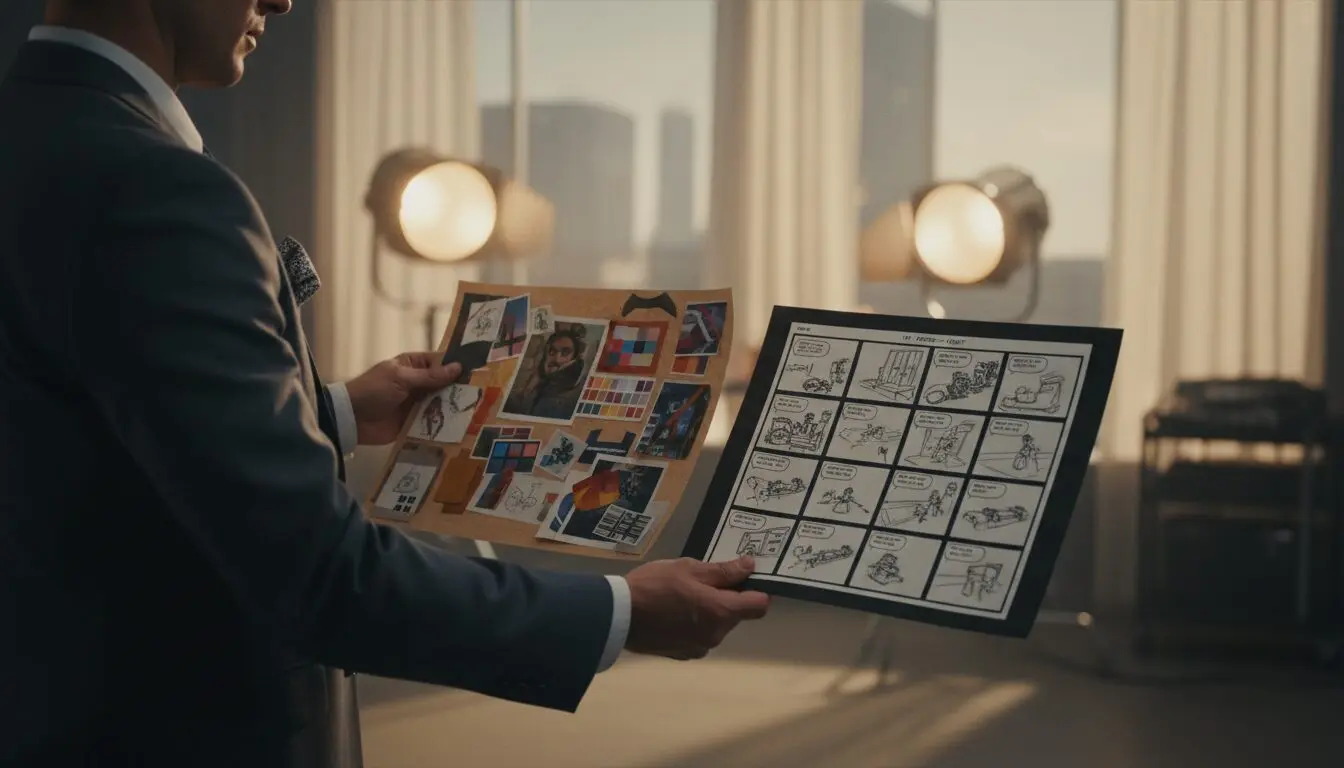
1. “Show me work that ran as real ads for real brands.” Demos and spec work prove tool access. Client work proves the vendor can survive feedback rounds, brand guidelines, and a deadline. Ask what the work achieved — views, CTR, sales lift — and whether you can verify it.
2. “How do you handle revisions?” AI generation is probabilistic, so a vendor without a real revision process will tell you “that’s just what the model gave us.” A professional studio budgets revision rounds into the price and owns the gap between what you asked for and what you got.
3. “Who does the creative direction?” If the answer is “the AI” or “you do,” you’re not hiring a production company — you’re hiring a render farm. The studios producing award-level work have human directors making hundreds of taste decisions per project.
4. “What’s your consistency pipeline?” Listen for specifics: character reference systems, custom-trained elements, shot-matching workflows. Vague answers here predict a final film where your protagonist changes face between scenes.
5. “What exactly do I receive?” Master file specs, aspect-ratio versions, cutdowns, source assets, usage rights. Get it in writing before work starts.
What it costs in 2026
Honest market ranges, based on what working studios actually charge: a 15–30 second social-first ad runs roughly $1,000–$2,500. A 30–60 second full commercial runs $2,000–$6,000. A 1–3 minute brand film runs $4,000–$10,000. (We’ve published a full breakdown of what drives these numbers in our AI commercial cost guide.)
For context, traditional production of the same deliverables typically starts at 5–10x those figures once you account for crew, location, talent, and equipment. That delta is the entire reason this category exists. But beware of the bottom of the market: if a quote is $300, you’re buying raw generations, not a commercial.
Red flags worth walking away from
A portfolio of only fantasy/sci-fi spectacle and no brand work — spectacle hides inconsistency; a packshot doesn’t. Pricing pages with no scope definition. No revision policy. Reluctance to do a discovery call before quoting. Delivery promises of 24–48 hours for a full commercial — concepting alone takes longer than that if anyone is actually thinking. And any vendor who can’t explain, in plain language, what they do that the tools don’t.
When AI production is the right call — and when it isn’t
AI production is the right choice when your concept benefits from worlds, characters, or visuals that would be unaffordable to shoot; when you need broadcast-feel quality on a social-media budget; when speed matters; or when you want to test multiple creative directions before committing media spend. One of our own spots — a stylized commercial for a cat-litter brand — reached over 1.6 million organic views on TikTok at a fraction of one traditional shoot day’s cost. The idea did that, but AI made the idea affordable.
Traditional production still wins when the brief requires real human performance with close-up emotional nuance, recognizable talent or spokespeople, or documentary authenticity. A good AI studio will tell you this in the first call. That honesty is itself a signal.
The bottom line
Choosing an AI commercial production company in 2026 is choosing a creative partner, not a tool operator. Judge them on shipped client work, creative direction, consistency pipeline, and what’s actually included — in that order. The technology is the cheapest part of the equation; taste and accountability are what you’re really buying.
If you’re evaluating studios for an upcoming campaign, we’re happy to be one of the contenders. Book a free 20-minute Vision Call — bring your brief, and we’ll tell you honestly whether AI production fits it, and what it would cost.
Frequently asked questions
An AI commercial production company is a multi-discipline shop that delivers broadcast-quality commercial spots end-to-end using generative video tools as the production engine. It is not an ad agency — no media planning or buying, no brand strategy mandate. It is not a SaaS tool — buyers do not log in and drive output themselves. The handoff is brief in, finished master out, on a fixed timeline. The ArcaneWiz vs HeyGen — premium vs self-service explainer shows the contrast cleanly.
End-to-end scope: discovery and brief sharpening, treatment and storyboard, AI concept frame generation, generative motion plates, multi-shot cinematic assembly, character and product continuity work, human edit and pace, colour grade to broadcast spec, sound design and mix, platform-spec deliverables and master, rights and licensing paperwork. A real production company owns every stage; a tool-led shop drops one or more. The ArcaneWiz production process page documents the production gates and ownership lines.
Short-form: write a one-page RFP with the brief, the deliverable spec, the budget band and the decision date; send to three shortlisted companies; require named Creative Director on the pitch call; score on tool stack, portfolio depth, contracting clarity and chemistry; decide within two weeks of pitch. Skip the 90-day enterprise RFP for under-$100K work — it loses you the talent you actually wanted. The how to choose an AI video production agency page carries the full scorecard.
2026 bands at ArcaneWiz: 15-second social cut $4,000–$22,000; 30-second hero spot $8,000–$45,000; 60-second narrative spot $15,000–$80,000. The range inside each tier maps to the production layer count — single-engine plates at the floor, full Midjourney plus Veo plus Kling plus Seedance stack with broadcast grade at the ceiling. Music and named talent sit outside the band. The AI commercial cost 2026 breakdown lists every line for each tier.
First cut on a 15- to 30-second AI commercial typically lands inside 5–10 business days from signed brief; final master with broadcast grade and platform exports follows 5–10 days after sign-off on revisions. Premium 60-second narrative work runs longer because character continuity and colour grade are discrete stages. For an extreme-cadence reference, see Kling 3 broadcast-quality AI commercial in 48 hours — that case study shows the engineering pre-conditions for a 48-hour brief-to-master cycle.
A real one does. ArcaneWiz handles broadcast technical clearance against CTV and linear specs, music licensing (commissioned, library, or sync), talent and voiceover rights, training-data carve-outs on generative footage, and the master rights chain documented for your finance and legal teams. A tool-only shop will hand you the raw export and leave clearance with you. Treat documented clearance as a hard buying criterion. The ArcaneWiz packages page itemises which tier carries which clearance work.
A short list serves enterprise at scale in 2026: the ones with named Creative Directors, multi-region IP coverage, six-figure billing rails, broadcast clearance practice, and a documented book of delivered commercial work. The market has consolidated — most credible enterprise-scale AI commercial work runs through a dozen shops, ArcaneWiz among them. Sub-scale studios still produce strong single spots but fail on enterprise governance. The top 10 AI video production companies 2026 round-up names the field with credit detail.
Standard practice: two revision rounds included on tier-bound packages, scoped against the signed brief; out-of-scope additions priced as change-orders against a published rate card. A clean shop publishes its change-order rates up front — Avid-level edit hour, colour hour, mix hour, named talent re-record. A messy shop quotes case-by-case, which is where overruns hide. ArcaneWiz’s revision and change-order policy lives in the ArcaneWiz production process page, with the per-stage gate detail.
Credible ones employ both. The Creative Director, DP and colourist drive shot grammar, frame composition, motion language and mix discipline; prompt engineers operate the tools inside that direction. ArcaneWiz’s Creative Director brings 20+ years of cinematography across broadcast, commercial and feature work — the reason our spots read cinematic rather than generative. A shop with only prompt operators delivers tool output. A shop with directors delivers commercials. Read why the director still matters in AI video for the underlying argument.
The 2026 reference stack at top commercial shops: Midjourney for concept frames and brand-aesthetic look-dev; Veo for photoreal motion and hero plates; Kling 3 for stylised cinematic motion and scene chaining; Seedance for character continuity across multi-shot work. A shop that names a single tool or hides behind ‘proprietary AI’ is signalling a thin engine room. The layer-by-layer rationale is in best AI video tools for marketing teams; to map it to your brief, book free AI video strategy call.