
The Production Landscape Has Changed — Here’s What Brands Need to Know
The question isn’t whether AI will transform video production — it already has. For brand marketers and creative directors evaluating their next campaign, the real question is: how does AI video production actually compare to traditional methods across the metrics that matter?
This guide breaks down the complete comparison — cost, timeline, quality, scalability, and creative control — so you can make an informed decision for your next project.
Cost Comparison: Where the Numbers Tell the Story
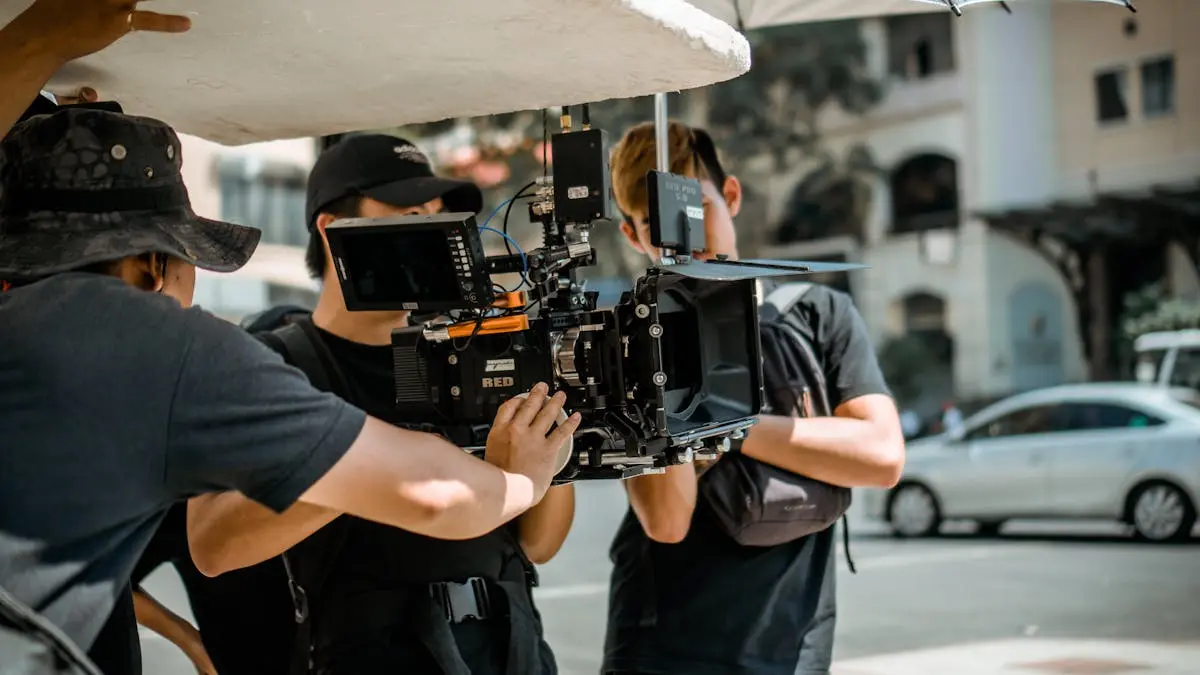
Traditional video production costs are well-documented — and consistently high. A single 30-second commercial typically runs between $50,000 and $500,000+ depending on complexity, talent, locations, and post-production requirements. Multi-spot campaigns can easily cross the $300,000 threshold before media spend even enters the conversation.
AI video production fundamentally restructures these economics. By eliminating location scouts, physical set construction, large crew calls, and multi-day shoots, AI-accelerated production typically delivers 60–80% cost savings compared to equivalent traditional output.
Consider the real-world math: a mid-size ad agency recently needed six 30-second hero spots for a national campaign across multiple aspect ratios. The traditional production quote came in at $320,000 with an 8–10 week timeline. Through AI-accelerated production with ArcaneWiz, the same scope was delivered for $89,000 — a 72% reduction — with 24 total assets delivered across four platform-specific formats.
The cost advantage compounds with volume. When a DTC skincare brand needed to scale from 2 product videos per quarter to 20 per month, their per-asset cost dropped from $6,000 to $600 — a 90% reduction — while maintaining their distinctive luxury aesthetic.
Timeline: From Weeks to Days

Traditional production timelines follow a sequential, dependency-heavy workflow:
- Pre-production (2–4 weeks): Script development, storyboarding, casting, location scouting, permits
- Production (1–3 days): Shooting days with full crew
- Post-production (3–6 weeks): Editing, color grading, sound design, VFX, revisions
Total: 6–12 weeks from brief to final delivery.
AI video production compresses this entire pipeline:
- Creative direction (1–2 days): Brief alignment, style frames, mood boards
- AI production sprint (2–3 days): Simultaneous generation of all assets
- Sound design and finishing (1–2 days): Professional audio, color grading, format delivery
Total: 5–10 business days from brief to final delivery. That’s an 80%+ reduction in production timeline.
For brands operating on compressed marketing calendars — seasonal launches, reactive campaigns, or competitive responses — this speed advantage isn’t just convenient. It’s the difference between capturing a market moment and missing it entirely.
Quality: The Gap Has Closed
The most common objection to AI video production is quality. Two years ago, that concern was legitimate. Today, it’s outdated.
Modern AI production pipelines — particularly those operated by specialized studios like ArcaneWiz that combine AI generation with professional cinematic direction — deliver output that is genuinely indistinguishable from traditional production at broadcast quality:
- 4K resolution with photorealistic lighting and atmospherics
- Physically accurate material rendering (fabric motion, liquid dynamics, surface reflections)
- Professional color grading and consistent visual identity across assets
- Broadcast-grade sound design and mixing
The key differentiator isn’t the AI technology itself — it’s the human creative direction layered on top. A skilled AI director applies the same principles of composition, pacing, and visual storytelling that make traditional cinematography compelling. The AI accelerates execution; the director ensures artistry.
Calculate Your AI Video ROI
See exactly what broadcast-grade AI production saves your brand — in dollars, days, and creative output. Free. 60 seconds.
Scalability: Where AI Production Truly Excels
This is where the comparison becomes most dramatic. Traditional production scales linearly — more assets require proportionally more time, crew, and budget. Doubling your output roughly doubles your cost.
AI production scales logarithmically. Once the creative direction, brand style, and visual language are established, producing additional variants, formats, or iterations adds marginal cost and time. A global industrial manufacturer recently used this advantage to produce and test 30 unique video variants across 5 international markets simultaneously — a scope that would have cost $1.8M and taken 14 weeks through traditional production.
This scalability unlocks strategies that were previously impossible for most brands:
- Multi-format delivery: Every spot delivered in 16:9, 9:16, 4:5, and 1:1 simultaneously
- Market-specific creative: Tailored messaging and visual approaches for different audiences
- Rapid A/B testing: Test 10 creative variants where you’d previously test 2
- Always-on content: Monthly production cadences that keep creative fresh and algorithms fed
Creative Control: More Iteration, Not Less

A common misconception is that AI production means surrendering creative control to an algorithm. The opposite is true.
With traditional production, revisions are expensive and limited. Reshoots can cost tens of thousands of dollars. Changing a location, wardrobe, or lighting setup after the shoot means starting over.
With AI production, creative iteration is fast and low-cost. Want to see the same spot with a different color palette? Different time of day? Different environment? These changes take hours, not weeks — and they don’t require reassembling a crew.
This means brands get more creative exploration, not less. You can test bolder concepts because the cost of being wrong is dramatically lower.
When Traditional Production Still Makes Sense
AI video production isn’t the right choice for every project. Traditional production retains advantages in specific scenarios:
- Real human talent is essential: Celebrity endorsements, spokesperson campaigns, or content where specific real people must appear on camera
- Live event coverage: Conferences, product launches, or documentary-style content capturing real moments
- User-generated content: Authentic customer testimonials and unscripted content
For everything else — brand commercials, product showcases, social content, explainer videos, campaign creative — AI production delivers equal or superior results at a fraction of the cost and timeline.
The Bottom Line for Brand Decision-Makers
| Factor | Traditional Production | AI Production (ArcaneWiz) |
|---|---|---|
| Cost per 30s spot | $50,000–$500,000+ | $10,000–$50,000 |
| Timeline | 6–12 weeks | 5–10 business days |
| Multi-format delivery | Additional cost per format | Included |
| Revision flexibility | Limited, expensive | Fast, low-cost |
| Scalability | Linear (2x output = 2x cost) | Logarithmic |
| Quality ceiling | Broadcast/Cinema | Broadcast/Cinema |
The brands winning in 2026 aren’t choosing between AI and traditional — they’re using AI production as their primary engine for volume, speed, and testing, while reserving traditional shoots for the specific scenarios where real-world capture is irreplaceable.
Related Reading
- Side-by-side results comparison
- Real results from AI-powered commercials
- AI video production cost breakdown
Ready to See the Difference?
If you’re evaluating AI video production for your brand, the best next step is seeing real output. Get started with ArcaneWiz to see how cinematic AI production compares to your current workflow — or explore our pricing tiers to find the right fit for your production needs.


Frequently Asked Questions

AI video production vs. traditional — which is right for a brand campaign?
It depends on the campaign’s needs, not on ideology. AI production wins when you need broadcast-quality brand and product films at volume, on a compressed calendar, with room to iterate. Traditional still earns the job for real-people testimonials, live events, and certain hero commercials. Most brands end up blending both. Our full breakdown of AI video vs traditional production compared maps the decision axis by axis.
What’s the real cost difference between AI and traditional video production?
Traditional cost is driven by crew, location, equipment, and shoot days; AI cost is driven by shot complexity and runtime, which removes most of the fixed overhead. That structural shift is what lets AI deliver comparable craft at a materially lower figure, freeing budget for media and variants. The line items are itemised in our AI video production cost breakdown.
How does the timeline compare between AI and traditional production?
A traditional spot typically runs 6–8 weeks across pre-production, shoot, and post. An AI production collapses that to a 5–10 business-day cycle, and a tightly scoped single-shot piece can reach a master inside 48 hours. The saving comes from removing scheduling, travel, and reshoots — not from cutting craft steps. See how we go from brief to broadcast in 48 hours.
Is AI video quality on par with traditional for broadcast?
For a large and growing share of shots, yes. Current-generation models such as Kling now produce motion, lighting, and detail that hold up on broadcast when a director controls shot design and grading. The gap survives mainly in sustained close-up human performance. Our worked example of a Kling 3 broadcast-quality AI commercial shows the standard on real footage.
When should a brand still pick traditional production over AI?
Choose traditional when authenticity is the message: real customer testimonials, live event capture, food and liquid hero shots, or a signature human performance that must feel unscripted. Regulatory or documentary contexts that require unaltered footage also favour a camera. We’ll tell you when that’s the right call — the honest side-by-side is in ArcaneWiz vs traditional production.
Can AI video and traditional footage be combined in one project?
Routinely, and it is often the strongest option. Live-action hero moments can carry the emotional beats while AI handles environments, scale, and coverage that would be costly to shoot, all reconciled in a single grade. Our Creative Director’s more than 20 years across both pipelines is what makes the seams disappear. The method is detailed in how AI and classical filmmaking combine.
What roles change when a brand switches from traditional to AI production?
Fewer logistics roles, more creative-direction weight. Location scouts, gaffers, and large crews give way to prompt and reference artists, editors, and colorists — but the director, storyboard, and post disciplines stay central. The craft judgement simply moves upstream into shot design and selection. We explain the reshaped workflow in how AI and classical filmmaking combine.
What are the IP and licensing differences between AI and traditional video?
Traditional footage carries talent releases, location permits, and music licences you must clear and archive. AI production shifts the questions to the terms of the generation tools and to clean ownership of the final master, while still requiring rights for any real brand assets, voices, or logos you supply. We deliver commercial-use masters and document the tool terms behind each project so your legal team can sign off with confidence.
How do clients evaluate AI vs. traditional output side-by-side?
The fair test is a blind one: put an AI-produced cut next to a traditional cut and judge composition, continuity, grade, and whether the story lands — without knowing which is which. Well-directed AI consistently holds up in that comparison. You can review real before-and-after work in our AI video case studies.
Are premium brands moving to AI video production in 2026?
Increasingly, yes — starting where volume and iteration matter most: product launches, social-first campaigns, and always-on brand content. The pattern is pragmatic rather than wholesale; brands move the workloads where AI clearly matches traditional craft and keep a camera for the rest. What that costs at each level is set out in ArcaneWiz pricing explained.
Ready to Transform Your Video Production?
Join the brands producing broadcast-grade commercials in days, not months — at 70–85% less cost.
Ready to transform your video production?
See what broadcast-quality AI video can do for your brand.