
What Is AI Video Production?
AI video production is the process of creating professional video content — commercials, brand films, product videos, and more — using artificial intelligence tools to handle tasks traditionally requiring large crews, expensive equipment, and weeks of post-production. In 2026, it has evolved from a novelty into a legitimate production methodology used by Fortune 500 brands and ambitious startups alike.
At its core, AI video production leverages generative AI models — such as Kling 3.0, Veo 3.1, and emerging open-source alternatives — to generate, enhance, or transform visual content. But the technology alone is only half the story. The real differentiator is creative direction: the human expertise that shapes raw AI output into cinematic, emotionally resonant content.
Studios like ArcaneWiz have pioneered this hybrid approach, combining classical filmmaking principles with cutting-edge AI tools to deliver production-quality results at a fraction of traditional costs.
How Does AI Video Production Work?

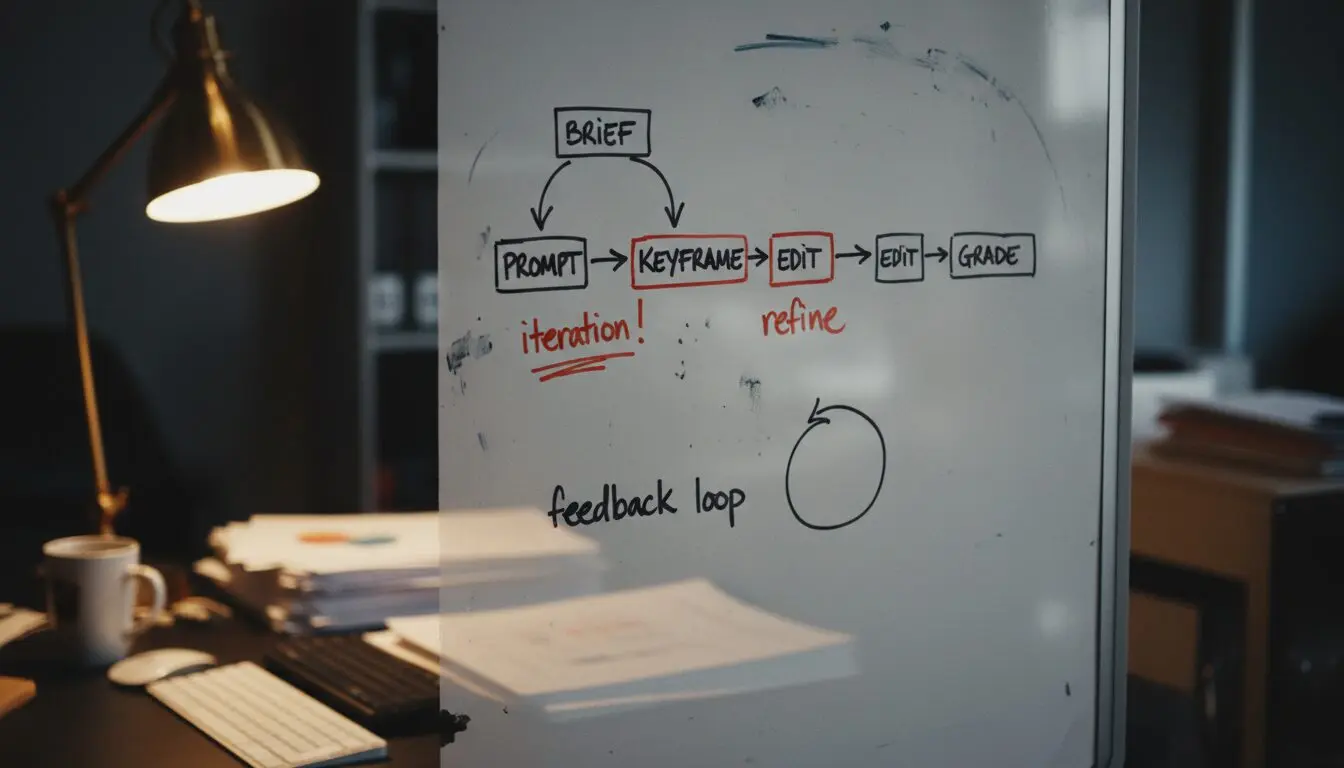
The AI video production workflow typically follows these stages:
1. Creative Brief & Concept Development
Every project starts with strategy. What is the brand’s message? Who is the target audience? What emotion should the video evoke? This stage is identical to traditional production — because great content always starts with great storytelling.
2. Script & Storyboarding
AI assists in generating script variations and visual storyboards. Tools can produce dozens of concept frames in minutes, allowing creative directors to iterate rapidly. However, the final creative decisions remain human-driven.
3. AI Generation & Compositing
This is where AI shines. Using text-to-video and image-to-video models, production teams generate raw footage, visual effects, environments, and character animations. Multiple generations are produced and the best elements are selected and composited together.
4. Post-Production & Refinement
Color grading, sound design, motion graphics, and final editing bring everything together. AI accelerates post-production workflows but experienced editors ensure the final product meets broadcast and digital standards.
5. Delivery & Optimization
Final videos are rendered in multiple formats — 4K for broadcast, vertical for social, compressed for web — and optimized for each platform’s specifications.
What Types of Video Can AI Produce?
AI video production is versatile enough to handle a wide range of content types:
- TV Commercials & Digital Ads — 15-60 second spots optimized for broadcast and streaming platforms
- Brand Films & Documentaries — Longer-form narrative content that tells a brand’s story
- Product Videos & Demos — Showcasing products in dynamic, visually compelling ways
- Social Media Content — High-volume content for Instagram, TikTok, YouTube Shorts
- Music Videos — Creative, visually experimental content that pushes artistic boundaries
- E-Commerce Video Ads — Performance-focused content designed to convert
To explore the full range of AI video capabilities, visit the ArcaneWiz portfolio for real-world examples.
AI Video Production Costs in 2026
One of the most compelling advantages of AI video production is cost efficiency. Here’s how it compares:
- Traditional TV commercial: $50,000 – $500,000+
- AI-produced commercial (premium studio): $5,000 – $25,000
- AI-produced social content: $500 – $5,000 per asset
That represents a 70-90% cost reduction without sacrificing quality. The savings come from eliminating location shoots, reducing crew sizes, and accelerating post-production timelines from weeks to days.
Use the ArcaneWiz AI Video ROI Calculator to estimate your potential savings based on your specific production needs.
The Tools Behind AI Video Production

The AI video landscape in 2026 is dominated by several key platforms:
Kling 3.0
Kuaishou’s flagship model has become the industry standard for commercial-grade AI video. With support for up to 4K resolution, consistent character rendering, and natural motion, Kling 3.0 is the go-to choice for professional studios.
Google Veo 3.1
Google’s latest video model excels at photorealistic environments and complex camera movements. Its integration with Google Cloud makes it particularly attractive for enterprise workflows.
Open-Source Alternatives
The open-source community continues to innovate with models like Wan2.1 and HunyuanVideo, offering competitive quality for teams with technical expertise to fine-tune and deploy them.
The Human Element
Tools are only as good as the people using them. The most successful AI video studios employ directors, cinematographers, and editors who understand classical filmmaking — light, composition, pacing, and emotion — and apply those principles to AI-generated content.
Who Is Using AI Video Production?
AI video production has been adopted across industries:
- E-Commerce & DTC Brands — High-volume product ads at scale
- Real Estate — Virtual property tours and lifestyle videos
- SaaS & Technology — Explainer videos and product demos
- Luxury Brands — Cinematic brand films with premium aesthetics
- Agencies — White-label production for client campaigns
ArcaneWiz serves clients across all these verticals. Explore industry-specific capabilities on the e-commerce, luxury brands, SaaS, and real estate pages.
How to Choose an AI Video Production Studio
Not all AI video studios are equal. Here’s what to look for:
- Creative direction expertise — Do they have filmmakers or just technicians?
- Portfolio quality — Does their work look cinematic or obviously AI-generated?
- End-to-end capabilities — Can they handle strategy, production, and delivery?
- Industry experience — Have they worked with brands in your sector?
- Turnaround time — Professional AI studios typically deliver in 3-10 business days

Frequently asked questions
They’re not. AI video generation is a model call — Veo or Kling renders a clip from a prompt. AI video production is the full pipeline that surrounds it: brief, treatment, styleframes, motion direction, editorial, color grade, sound design, deliverables. Generation is one of seven craft steps inside production. A team buying “AI generation” gets clips; a team buying production gets a finished commercial that ships. See best AI video tools for marketing teams for the distinction across the stack.
Seven stages, run in parallel where possible. Brief and creative strategy. Director’s treatment and reference deck. Styleframe lock (image models render the looks the director signs off). Motion generation per shot (cinema-grade clips, with retakes). Editorial cut and pacing. Color grade and finishing. Sound design, mix, and master deliverables in the formats the brand actually needs — broadcast, paid social, vertical, audio variants. Same shape as a traditional shoot, but with renders instead of a crew day. The ArcaneWiz production process walks each stage in order.
Midjourney handles styleframe and reference image generation — the look the director needs locked before any motion runs. Veo and Kling cover motion: Veo for naturalistic camera language and on-screen performance, Kling (Kling 3 specifically) for broadcast-grade lift, dramatic lighting, and the high-end cinematic shots that pass linear-TV QC. Seedance fills in performance acting beats where character continuity matters. The orchestration matters more than the model choice — directing the stack is the craft. See best AI video tools for marketing teams for use-case fit.
Yes, with a caveat. The shoot day, location, lighting, and crew costs collapse — that’s where the savings come from. Director time, color grade, sound design, and project management don’t compress; those are craft hours and they carry the work. Comparable-craft AI production typically runs a meaningful fraction of a traditional shoot at the same quality bar — the destination page itemizes the bands. Below that range, you’re buying generic clips, not a directed commercial. See AI video vs traditional cost, speed, quality for the line-item comparison.
It compresses both phases. Brief-to-styleframe lock takes days, not weeks (Midjourney iteration is the unlock). Motion generation per shot is hours, not days — and unlike a traditional shoot, retakes don’t require a re-shoot. Revisions don’t carry re-shoot cost, so directors take more of them and the final cut lands closer to the original creative intent. The honest answer: revision cycles are tighter and more frequent, and the timeline still compresses meaningfully versus traditional. See brief to broadcast in 48 hours for the time-compressed workflow.
Yes — paid social comfortably, broadcast TV with the right tool stack and a director-led QC chain. Kling 3 outputs hit linear-TV specs when paired with professional color grade, sound mix, and master delivery in the formats the network requires. The bottleneck isn’t the model anymore; it’s the craft layer around it. Brands airing AI commercials in 2026 are running directed pipelines, not prompt-to-export. See Kling 3 broadcast-quality AI commercial for the QC chain that gets work on air.
The brand. Reputable production agencies contractually assign rights — final master, source files where applicable, exhibition rights in perpetuity — to the brand on delivery. The tool vendor doesn’t claim ownership of model output (Midjourney, Veo, Kling, Seedance commercial tiers all grant commercial-use rights), but their TOS govern training-data use and disclosure. Always require a written rights-assignment clause and a tool-stack disclosure in the SOW. If an agency won’t disclose the tools, walk. The how to choose an AI video production agency guide covers the contract checklist.
All of them — restructured, not eliminated. The director shapes vision, performance, pacing. The DP becomes a camera-language director — composition, lens choice, motion grammar expressed through tool parameters. The colorist still grades; the work is harder, not easier, because AI base layers need disciplined finishing. The sound designer scores, mixes, masters. ArcaneWiz is led by a Creative Director with 20+ years across cinematography, color, and sound, which is why the work passes broadcast QC. The deeper argument is in why the director still matters in AI video.
A production project delivers: hero master (broadcast spec where required), platform-aware cutdowns (16:9, 9:16, 1:1, audio-on/off), audio variants (full mix, music-bed, dialogue-only), reference styleframes, project source where contractually agreed, and a signed rights assignment plus tool-stack disclosure. Brands airing on linear TV also receive network-ready submissions per broadcaster spec. Anything less is generic-clip delivery, not production. See the ArcaneWiz production process for the standard deliverable manifest by tier.
Three honest limits. Hyper-realistic human performance at extended duration — a four-minute single-take dialogue scene still favors a traditional shoot. Specific named talent — celebrity casting requires either a licensed likeness deal or a traditional shoot. Brand-archival realism for legacy product lines where every prop must match decades of catalog continuity. Outside those, AI production matches or exceeds traditional at the broadcast bar. See the AI video production cost breakdown and our AI video case studies for the work shipped in production.